

 By
By The Kerala government is making a fresh attempt to move forward with its ambitious semi-high-speed rail project known as SilverLine or K-Rail. Recently, state officials met with Union Railway Minister Ashwini Vaishnaw to discuss the future of this massive transport plan.
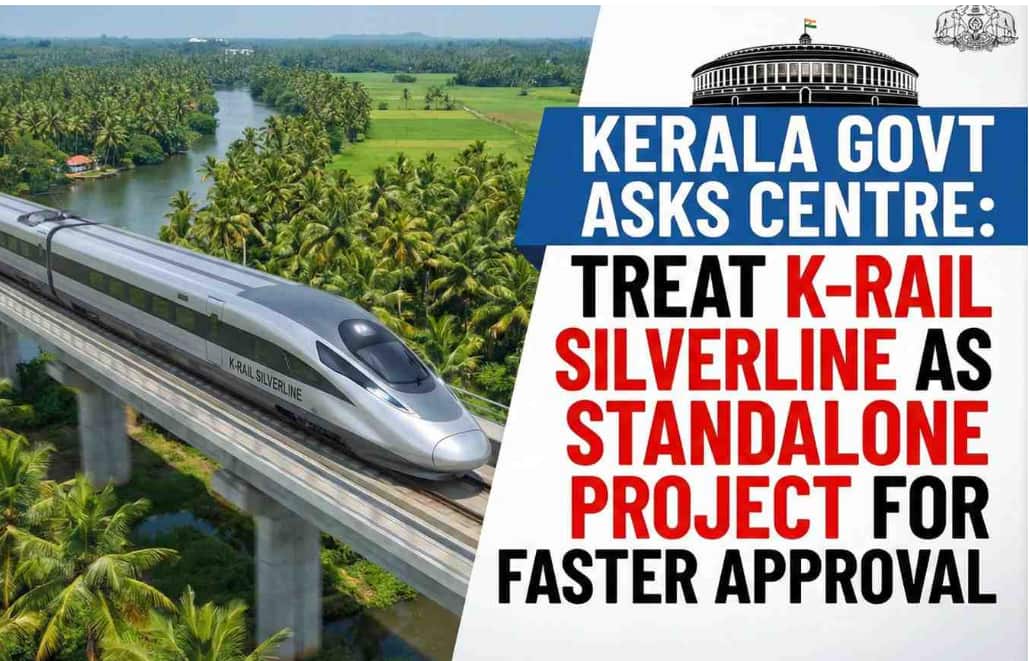
During these discussions, the Kerala government requested that the project be treated as a standalone initiative. This means the state wants the central government to evaluate the SilverLine project on its own merits rather than comparing it strictly with the existing national railway network or other standard rail projects.
The SilverLine project is designed to connect the southern part of Kerala to the northern tip in a much shorter time. Currently, traveling from Thiruvananthapuram to Kasaragod by train can take up to twelve hours because the existing tracks have many curves and the trains must move slowly. The new project aims to reduce this travel time to less than four hours by using a dedicated set of tracks where trains can run at high speeds. The state government believes that this project is essential for the modern development of Kerala and will help millions of people save time and energy every day.
One of the biggest hurdles for the project has been getting the final green signal from the Railway Board and the Central Government. Railway Minister Ashwini Vaishnaw has asked the Kerala government to revise the Detailed Project Report, which is often called the DPR. A DPR is a thick document that explains all the technical details, costs, and the path the train will take. The minister pointed out that certain technical aspects and environmental concerns need more study before the project can be approved. By revising the report, the state hopes to answer all the questions raised by the central authorities.
The Kerala government argued that treating K-Rail as a standalone project would help in solving many technical disagreements. When a project is standalone, it can have its own specific rules for how the tracks are built and how the money is managed. This is important because the SilverLine is a joint venture between the state and the railways, and both sides need to agree on how much money each will spend. The state is very eager to start the work because they believe it will create thousands of new jobs and boost the local economy by making it easier for businesses to move goods across the region.
However, the project has also faced some protests from local people and environmental groups. These groups are worried about the land that will be needed for the tracks and how the construction might affect the nature of Kerala. The central government is taking these concerns seriously and has asked the state to ensure that the environment is protected. The Railway Minister mentioned that while the government wants to support development, it must be done in a way that is safe and helpful for everyone in the long run.
The next step for the Kerala government is to work on the changes requested by the Union Minister. Once the revised report is submitted, the central government will look at it again to see if it meets all the safety and financial rules. Both the state and the center are now trying to find a common ground so that the project can move forward without more delays. Everyone is waiting to see the final plan, as a successful K-Rail could change the face of travel in Kerala forever.
The Kerala government has urged the Centre to treat the K-Rail SilverLine as a standalone semi-high-speed rail project to speed up approvals. Designed to cut Thiruvananthapuram–Kasaragod travel time to under four hours, the project awaits clearance after revisions to its Detailed Project Report. While promising economic growth and faster connectivity, SilverLine also faces environmental and land acquisition concerns.