

 By
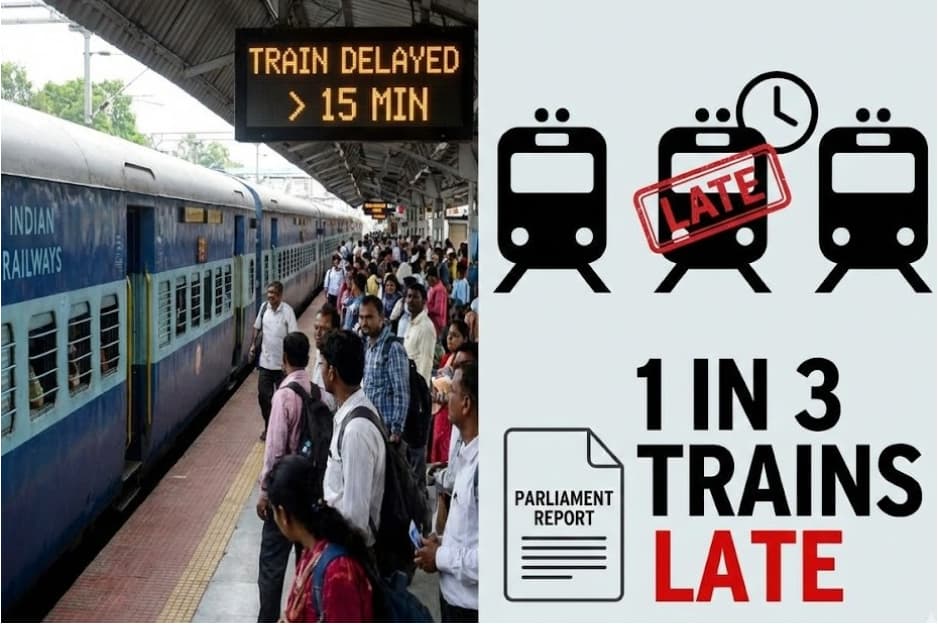
By A recent study by a powerful group of lawmakers has raised big questions about how Indian Railways keeps track of time. Even though the railway uses a very generous rule that considers a train “on time” even if it is fifteen minutes late, one in every three trains is still failing to meet its schedule. This news comes from the Public Accounts Committee of Parliament, which presented its findings on February 4, 2026.
In India, if a train reaches its final destination up to fifteen minutes after the scheduled time, the railway still marks it as being “on time.” This extra cushion is called a “leeway” or a threshold. The parliamentary committee pointed out that this system is much more relaxed than in other countries. For example, in Japan, a train is considered late if it is off by just a few seconds. In the Netherlands, the limit is three minutes.
Because India’s limit is so high, the committee says the official numbers might make the railways look better than they actually are. They believe this narrow approach does not show the true picture of what passengers experience during their journey.
Another major issue discovered in the report is how the time is recorded. Currently, Indian Railways mostly checks if a train is punctual only when it reaches the very last station of its trip. This means a train could be delayed by several hours at a station in the middle of the journey, but if the driver moves very fast and catches up by the end, the train is still officially marked as punctual.
The committee noted that this system is misleading. A passenger who gets off at a middle station after a long delay still feels the train was late, even if the official records say otherwise. To fix this, the report recommends a new system called “Integrated Monitoring.” This would track the train’s time at the starting station, every middle station, and the final stop to give a more honest report.
The report looked at over six lakh trains and found that about one lakh eighty-two thousand did not meet the fifteen-minute target. There are many reasons why this happens, and the committee found that twenty-seven out of thirty-three common causes for delays are actually within the control of the railways.
Internal problems like old tracks, signal failures, and slow pace of modernizing infrastructure are the main culprits. Congested tracks are another big issue because there are too many trains trying to use the same lines. While external factors like bad weather or cattle on the tracks do cause some delays, they only account for a small part of the total problem.
Chronic delays cause a lot of stress for passengers and affect the movement of goods across the country. The committee has asked the government to reset its timelines and adopt stricter standards that reflect what the public actually expects. They suggested using modern technology and digital tools to capture real-time data more accurately.
While some railway divisions like Vijayawada and Madurai have shown very high punctuality recently, the overall national average needs to improve. As India invests billions into new projects like the Bullet Train and better railway stations, the goal is to make sure that the “on-time” promise is something every passenger can truly depend on.
A Parliamentary Public Accounts Committee report reveals that one in three Indian trains runs late despite a 15-minute “on-time” leeway rule. The panel criticized the current system of measuring punctuality only at final destinations and recommended integrated monitoring across all stations. Most delay causes were found to be internal, including congestion, signal failures, and infrastructure gaps.