

 By
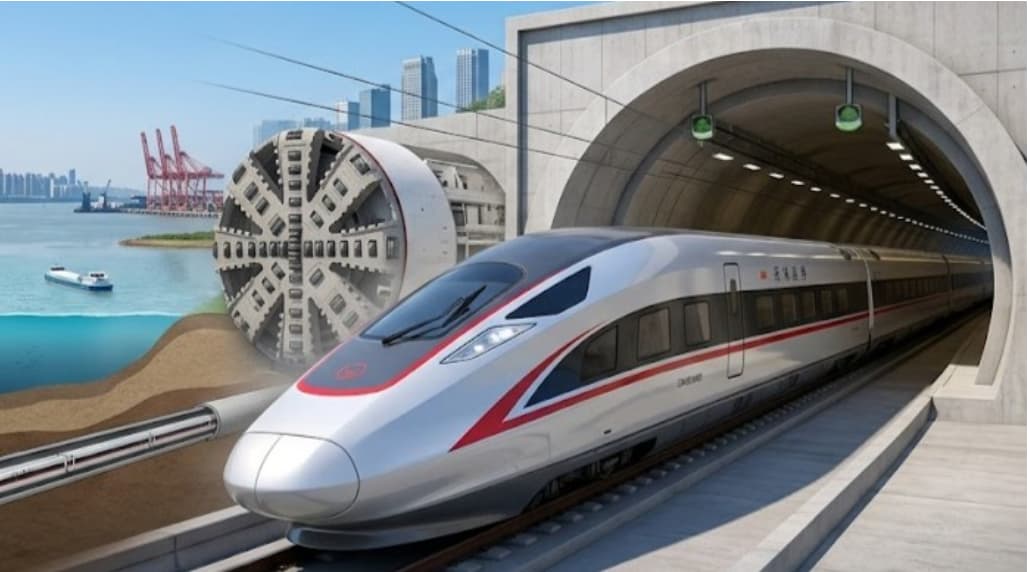
By China has just finished an amazing piece of construction that will change how people travel. Engineers have completed digging a brand new tunnel deep under the Yangtze River. The Yangtze is the longest river in all of China and the third longest river in the whole world. This new tunnel is very special because it is made only for high-speed trains. When it opens, it will allow trains to travel underwater at incredibly fast speeds. This news is very exciting for anyone who loves big engineering projects and fast travel.
The new train tunnel is very long. Its total length is more than fourteen kilometers. Out of this total distance, over eleven kilometers are completely underwater beneath the giant river. The tunnel will connect a district in Shanghai, called Chongming, with a city named Taicang in the Jiangsu Province. Because the tunnel is designed so well, the new high-speed trains will be able to cross the water at speeds up to three hundred and fifty kilometers per hour. This will make crossing the river much faster and easier than ever before.
This underwater tunnel is a very important part of a much bigger railway project in Eastern China. It belongs to the new high-speed railway line that will connect the major cities of Shanghai, Nanjing, Chongqing, and Chengdu. In the future, this specific tunnel will connect to a giant, unified railway network that covers the entire country. China is building a massive web of train tracks that includes eight main routes going north to south, and eight main routes going east to west. This means people will be able to travel across the huge country very smoothly.
Building this tunnel perfectly matches the Chinese government’s big plan to grow their high-speed train system as quickly as possible. China opened its very first high-speed railway back in the year two thousand and eight. That first line connected the capital city of Beijing with Tianjin. Since then, the country has built tracks at a very fast pace. By the end of two thousand and twenty five, the total length of all high-speed railways in China crossed fifty thousand kilometers. This makes it the largest high-speed train network in the world.
Experts from the China Railway Economic and Planning Research Institute say these fast trains have completely changed how citizens travel. Before these trains existed, traveling across China took many days. Now, if someone wants to visit a nearby city that is five hundred kilometers away, the trip takes only one or two hours. Traveling between very large cities that are a thousand kilometers apart takes just four hours. Even huge journeys of more than two thousand kilometers can now be finished in a single day. This saves people a lot of time and makes doing business much easier.
China is not stopping here. The government has very big plans for the future of train travel. They want to increase the total length of their high-speed railways to sixty thousand kilometers by the year two thousand and thirty. They hope to reach seventy thousand kilometers by two thousand and thirty five. At the same time, Chinese engineers are working hard to make the trains even faster than they are today.
In late two thousand and twenty four, China showed a new prototype train in Beijing. This special train is designed to travel at four hundred kilometers per hour. During its test runs, it actually reached a top speed of four hundred and fifty three kilometers per hour. Even more amazing, researchers recently tested a magnetic train that reached an unbelievable speed of seven hundred kilometers per hour in just two seconds. As China continues to build amazing structures like the Yangtze River tunnel, they are proving to the world that the future of travel will be incredibly fast and efficient.
China has completed a groundbreaking high-speed railway tunnel beneath the Yangtze River, enabling trains to run underwater at speeds up to 350 km/h. Connecting Chongming in Shanghai with Taicang, the project is part of a massive national rail expansion. This engineering achievement highlights China’s rapid progress in high-speed rail infrastructure and future-ready transport technology.