

 By
By The dream of traveling between Bengaluru and Chennai in less than the time it takes to watch a movie is moving closer to reality. In a major announcement during the Union Budget 2026, the Indian government introduced a plan for 7 new high-speed rail corridors across the country. One of the most exciting routes in this plan is the Bengaluru-Chennai bullet train, which is set to bridge the distance between these two mega cities at lightning speed.
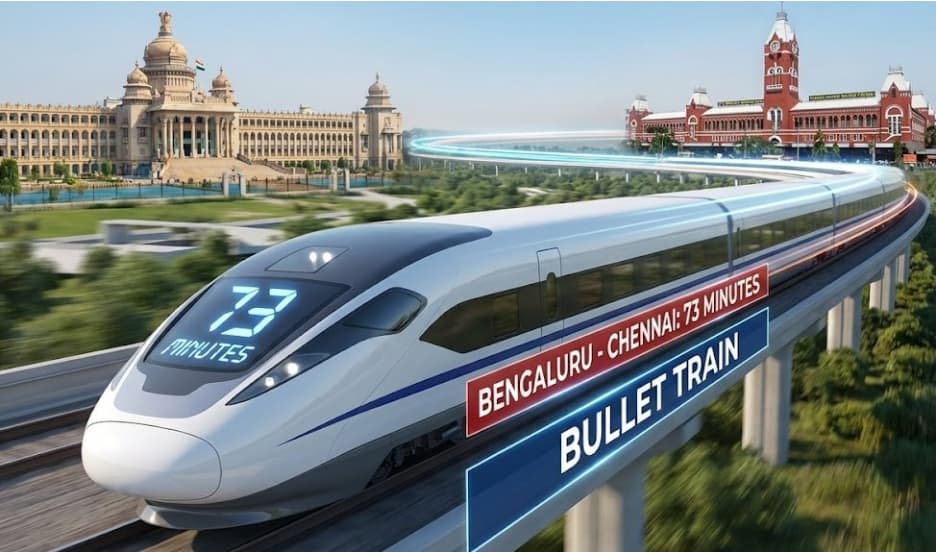
Union Railway Minister Ashwini Vaishnaw shared that this high-speed corridor will reduce the travel time between Bengaluru and Chennai to just 1 hour and 13 minutes. Currently, the fastest trains like the Vande Bharat Express take over 4 hours, while traveling by road or regular rail can take 6 hours or more. This massive reduction in time will essentially merge the two cities into one large economic zone. People will be able to live in one city and work in the other, or finish a business meeting and return home in time for dinner.

The new bullet train is designed to run at a maximum speed of 350 kilometers per hour. To reach these incredible speeds, the train will run on a dedicated track that is completely separate from the existing railway lines. This Diamond Quadrilateral project aims to connect the major IT and manufacturing hubs of South India, including Hyderabad, Bengaluru, and Chennai. By linking these cities, the government hopes to create a growth connector that will boost the economy for millions of people in Karnataka, Tamil Nadu, and Telangana.
The proposed route for the Bengaluru-Chennai section will cover about 306 kilometers. While the final list of stations will be confirmed in a few months, early plans suggest key stops in both states to ensure many people can access the service. In Bengaluru, the project might include underground stations at Whitefield and Baiyappanahalli to avoid disrupting the busy city streets. Other possible stops along the way include areas like Kolar and parts of Andhra Pradesh, making it easier for people in smaller towns to reach the big cities quickly.
Building this high-speed rail will be a massive task that requires advanced engineering and significant investment. The government expects to spend around 16 lakh crore rupees on all 7 proposed corridors. Engineers will use a mix of elevated tracks and underground tunnels to navigate through mountains and crowded urban areas. For example, a tunnel of nearly 12 kilometers is being considered within Bengaluru city itself to save space and reduce the need for clearing land on the surface.
This project is not just about speed but also about a greener future for India. High-speed rail is much better for the environment than traveling by car or plane because it uses electricity and carries hundreds of passengers at once. As the work on the first bullet train between Mumbai and Ahmedabad progresses, the government is ready to use that experience to build the Bengaluru-Chennai line even faster. While construction may take several years, the promise of such fast travel is already creating a lot of excitement for the future of South India.
The proposed Bengaluru–Chennai Bullet Train corridor, announced in Union Budget 2026, aims to cut travel time to just 73 minutes. Designed for speeds up to 350 kmph, the 306 km high-speed line will connect major South Indian economic hubs through dedicated elevated and underground tracks. The project is part of India’s broader Diamond Quadrilateral vision to transform intercity travel and boost regional growth.