

 By
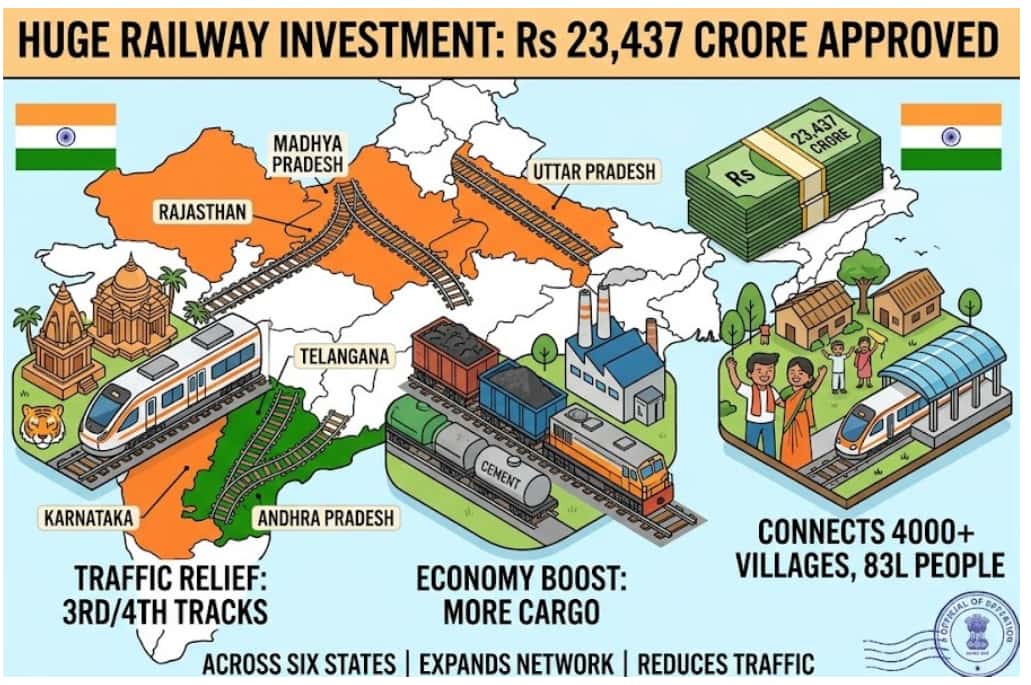
By The Indian government has just made a major decision to build new railway tracks across the country. A special government group called the Cabinet Committee on Economic Affairs has approved three massive railway projects. The total cost of these projects is a huge sum of twenty-three thousand four hundred and thirty-seven crore rupees. The main goal of this big investment is to expand the railway lines and make travel much faster and easier for millions of people across six different states.
The three new projects will focus on adding third and fourth tracks to very busy railway routes. These projects are the Nagda to Mathura route, the Guntakal to Wadi route, and the Burhwal to Sitapur route. Together, these upgrades will add about nine hundred and one kilometers of new tracks to the Indian Railways network. The construction will take place across nineteen different districts in Madhya Pradesh, Rajasthan, Uttar Pradesh, Karnataka, Andhra Pradesh, and Telangana. The government hopes to finish all the construction work by the year two thousand and thirty-one.
One of the biggest problems on Indian tracks today is train traffic. Right now, passenger trains and heavy cargo trains must share the same railway lines. Because the lines are so crowded, trains often have to stop and wait, which causes long delays. By building these third and fourth lines, trains will have much more room to move. This extra space will help reduce traffic jams on the tracks, making train journeys much more reliable and punctual for everyday travelers.
This massive project will also bring great benefits to local villages and communities. The government says the new lines will connect and help more than four thousand villages. Nearly eighty-three lakh people living in these rural areas will get better access to big cities. This makes it easier for them to travel for work, go to hospitals, or send their children to schools and colleges. Additionally, the construction work will create thousands of new jobs for local laborers and engineers.
Travelers and tourists will also find it much easier to visit famous places in India. The new tracks will improve train travel to highly popular spiritual and holiday sites. These include the famous Mahakaleshwar Temple in Ujjain, the holy town of Mathura, and beautiful wildlife areas like Ranthambore National Park and Kuno National Park. With smoother train journeys, more tourists can travel comfortably, which will help local hotels and shops earn more money.
Apart from carrying passengers, the new tracks are very important for moving goods like coal, cement, food grains, and steel. The upgraded network will allow the railways to carry an extra sixty million tonnes of cargo every year. This is highly beneficial for businesses because moving goods by train is much cheaper and faster than using roads.
This plan is also wonderful news for the environment. Moving cargo on trains instead of big trucks will save about thirty-seven crore liters of imported oil. It will also stop a huge amount of harmful carbon dioxide gas from entering the air. The government says the positive effect on the environment is as grand as planting seven crore trees. By choosing trains over trucks, India is taking a major step toward keeping its air clean while building a stronger economy for the future.
The Indian government has approved three major railway expansion projects worth ₹23,437 crore across six states. The projects will add third and fourth railway lines on busy routes, improving passenger travel, freight movement, and connectivity for over 4,000 villages. The upgrades are expected to reduce congestion, support tourism, increase cargo capacity, and deliver significant environmental benefits by lowering road transport emissions.